
Christopher Nolan’s ambitious mission was to write and direct this mythological, fantastical, adventure of epic proportions reimagining the 20-year journey of legendary King Odysseus. Cinematically, he succeeds for the first time using breakthrough IMAX technology for the entire film, enduring difficult, demanding conditions in production for cast and crew.
Nolan, along with co-Producer and wife Emma Thomas, wanted the story to follow his hand-picked ensemble playing characters showing the mystery, romance, horror, battles, bravery, and determination they faced in Homer’s 3 thousand year old epic poem. Nearly 3 hours long, we wondered how writer/director Christopher Nolan would take us through the journey by Odysseus, Greek King of Ithaca, (Matt Damon – Interstellar, The Odyssey) vowing to return to his beloved Queen Penelope (Anne Hathaway – Interstellar, The Dark Knight Rises) after the Trojan War. We see Odysseus inside the Trojan Horse half buried on the beach. It is not a gift but intended to be recovered by the Spartans, who don’t know what’s inside, resulting in a huge massacre. But we had some questions about the confusing portrayals in flashbacks in the first hour.
Damon took on, what even he called, the hardest physical role of his movie career. He had to train, lose weight and grew his own beard for a year, ordered by Nolan. He also was heard extreme screaming in his trailer, not from pain, but trying to lower the tenor of his voice to make him sound hoarser and older as his character aged through the film. Hathaway is stoic and restrained, longing for the return of her husband while suitors party hard at her expense vying to take Odysseus’ place in marriage and the crown.
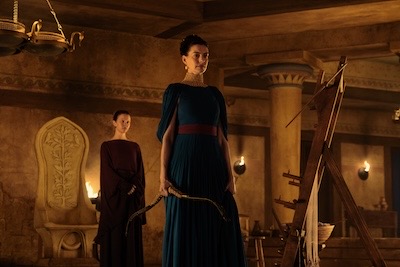
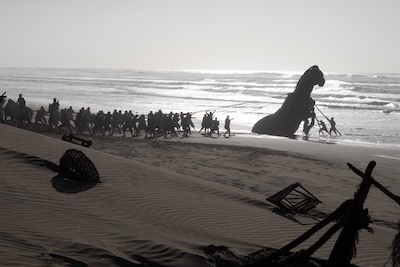
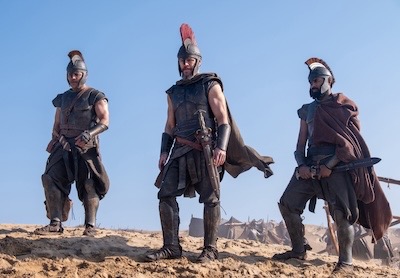
Damon, Tom Holland, Robert Pattinson and Ann Hathaway, and Lupita Nyong’o lead the way, with John Leguizamo in an inspired supporting role as the blind swineherd Eumaeus as the stalwart supporter of Odysseus. Nolan’s depictions of the characters the Greek Hero encounters in flashback on his 20-year journey include the 3 C’s, the Cyclops Polyphoemus, Circe, and Calypso (Bill Irwin, Samantha Morton, Charlize Theron, respectively). The scene with the Cyclops is frightening. Morton’s is exceptional in her performance graphically transforming men into pigs. It is highly disturbing. Unfortunately, Theron is not given much to work with as Calypso keeping Odysseus occupied with sex and drugged by lotus blossoms to keep him from going back to Penelope. Nolan doesn’t include any scenes with lust. Odysseus is depicted as an asexual sex slave.
Zendaya (The Spider-Man and Euphoria) is cast as the Zeus’ daughter, the Goddess Athena. She is a divine presence and guide trying to help Odysseus when he encounters Poseidon’s raging storms at sea, a weird whirlpool and other obstacles on his journey back to Ithaca back to his loving wife, Penelope.
Robert Pattinson (The Drama, Lighthouse) plays the sneering, scheming coward in his first role as a villain. He really got into character. Pattinson is sleazy and smarmy as the suitor who wants to bed and wed Queen Penelope (Hathaway) so he can take the crown and kill Telemachus out of succession. His patience is wearing thin.
The first hour seems chaotic showing characters interacting with Odysseus in flashback. It seemed to drag and be distracting and difficult to understand what was happening in this story. Once Nolan gets back on track with Odysseus on his journey, it flows better. We also found the writer/director’s choice of language style unexpected and a bit too contemporary. It took awhile to acclamate to the sound and rhythm of the characters’ speaking in American English rather than more classical using a British accent. It seemed out of place for Tom Holland as Telemachus, referring to parents (Damon and Hathaway) as “Mom” and “Dad.” Holland is believable as the dutiful son, who never knew his father, but so dedicated to finding him while keeping the suitors away from his mother, and protecting his legacy. It is interesting and relevant that Nolan set his characters in the Bronze Age, plus making it feel relevant talking in the language of today’s world.
Nolan, once again, employs the talent of composer Ludwig Göransson music (Tenet, Oppenheimer) using bronze gongs and other instruments made of the metal, plus lyres to create the sounds of that era. Particularly prominent are the heavy drum beats while so many men are rowing in cadence on the ship, and as action ramps up in brutal battle. It creates the pounding undertone of the time.
Christopher Nolan first saw IMAX in action at the age of 16 at the Museum of Science and Industry in Chicago and was so fascinated by it he dreamed of using it to make a movie of his own some day. Once again, Hoy Van Hoytema (Oppenheimer, Tenet, Dunkirk, Intersteller) is Nolan’s Cinematographer of choice. But Director Nolan wanted to shoot the whole film using IMAX cameras which are way too noisy for scenes with soft dialogue. IMAX came up with a new smaller, but still heavy camera that could fit inside small blimp-like-structures to minimize the sound. But they could only shoot 3 minutes of a scene at a time. And they came up with using mirrors while shooting so the actors could keep eye contact with each other, since the camera was rolling in a big box-like blimp to minimize the sound. That was another challenge for the actors, but it worked. Credit to Jennifer Lame (Tenet, Oppenheimer, Marriage Story, Hereditary) for her work editing her own 3-hour challenge. Nolan alotted 100 days to shoot the film, but finished 91 days in and under budget using these new lighter IMAX cameras.
There was criticism of Lupito Nyong’o being cast as Helen of Troy, “the most beautiful woman in the world” according to Homer’s Odyssey. The actress refused to acknowledge the criticism and Nolan has made clear that he cast Nyong’o for her talent as an exceptional artist, not her skin color. She is powerful in her scenes.

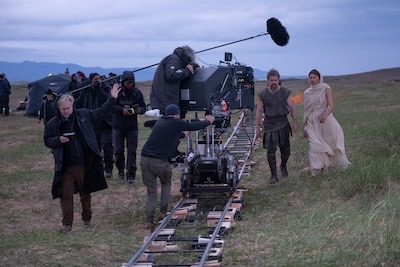
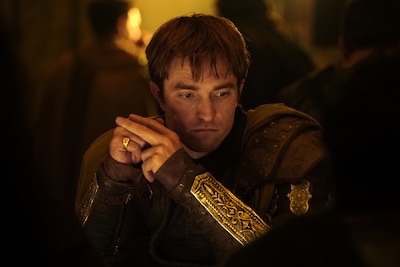
Christopher Nolan’s spin on this tale is not unlike his previous Oscar winner Oppenheimer. He can be forgiven for taking liberties with the usual conceptualizations of the Homeric tale, even with some incongruous casting. In both films, countless lives weigh in the balance. The hero in each story wrestled with a moral dilemma. In Oppenheimer, it was whether to unleash the atom bomb on civilians in Hiroshima and Nagasaki. For Odysseus, it was using the Trojan Horse pretending to be a gift, the Trojan to cruelly surprise and slaughter innocents in Sparta. Both Oppenheimer and Odysseus had inner conflict.
Christopher Nolan and Matt Damon took on this near impossible task. Nolan conceptualized, wrote, directed, cast and found a new way to use the largest screen format to make this epic tale even grander. Interested in how films are made? This is a must see.
Universal Pictures 2 Hours 52 Minutes R
Related posts:
 Oppenheimer
 Two Women
 Dunkirk
 Knives Out Writer/Director Rian Johnson talks about having the whole cast on the set
 Ford v Ferrari Stunt Coordinator, Robert Nagle
 Interview with Waves stars Kelvin Harrison, Jr., Taylor Russell and Writer/Director Trey Edward Shults talking teen angst, family and sound design.